

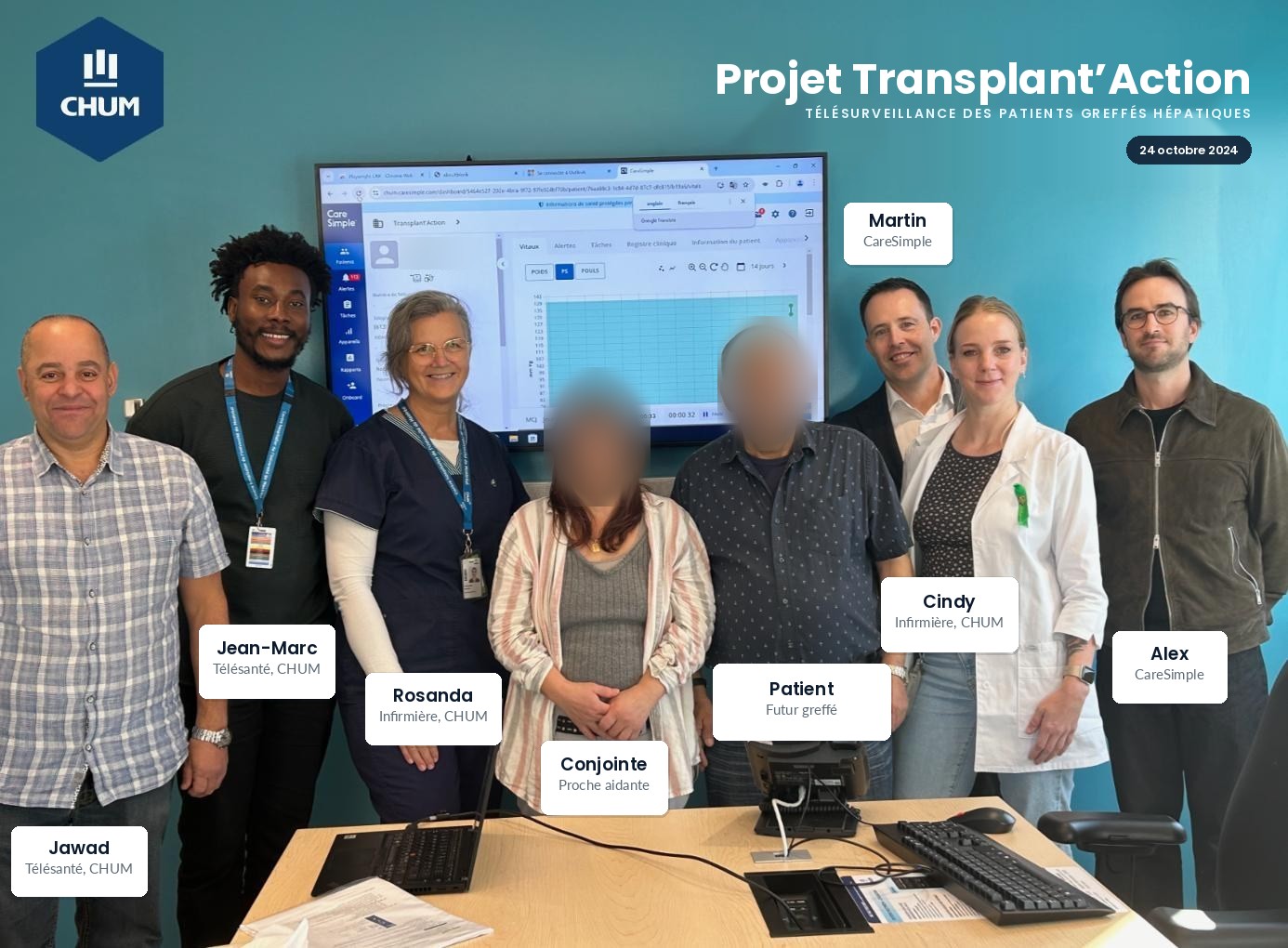
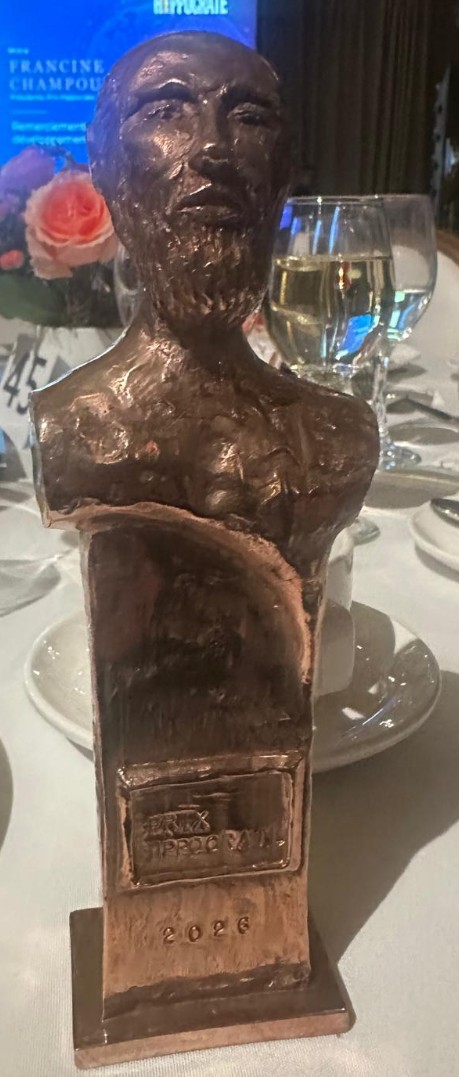
On October 29, 2026, in Montréal, the Centre hospitalier de l’Université de Montréal (CHUM) received the Grand Prix Hippocrate 2026, Transformateur category, the highest distinction of Québec’s annual healthcare innovation awards, for its Transplant’Action Connectée (Liver, TAC-F) program. Earlier the same evening, the program had already won the Prix innovation Jean-Paul Marsan for the transformation of complex care pathways and value creation in health.
The whole CareSimple team extends its warmest congratulations to Dr. Marie-Pascale Pomey and to the CHUM’s liver transplant clinic, research team, nursing directorate and peer mentors. We have had the privilege of serving as the program’s telemonitoring technology partner since its launch, and this recognition belongs to them.
About the CHUM
The CHUM is one of Canada’s largest academic health centres and one of only two adult liver transplant programs in Québec, both located in Montréal. It performs 60 to 75 liver transplants a year and receives patients from every region of the province, many of them hundreds of kilometres from the hospital. Its research centre, the CRCHUM, led the evaluation of TAC-F, first funded by the Institut de la pertinence des actes médicaux (IPAM) and now by Québec’s Ministère de la Santé et des Services sociaux.
The program is led by Dr. Marie-Pascale Pomey, MD, PhD, professor at the Université de Montréal, senior clinician-scientist at the CRCHUM and scientific co-director of the Centre of Excellence on Partnership with Patients and the Public, one of the world’s leading voices on patient partnership in care design.
The problem: a long, fragmented pathway
A liver transplant journey runs from the eligibility work-up to a full year after surgery. During the wait, patients grow frailer and more malnourished, and every missed or poorly coordinated appointment translates into days of fragile life. Before TAC-F, each stage of that journey belonged to a different team. Patients repeated their story to every new provider, did not know whom to call when a symptom appeared, and sometimes did not even know whether they were still on the waiting list.
The model: five components, one integrated team
Rather than adding a tool or a position, the CHUM rebuilt the pathway longitudinally around the patient, applying the principles of Value-Based Health Care. Five components work together:
- A single interdisciplinary team of physicians, nurses, a dietitian and a kinesiologist follows the patient from pre-transplant to one year post-transplant, with no hand-offs between teams.
- A co-built exercise and nutrition plan, designed with the patient on a dedicated “Day Zero” and adjusted over time.
- Cellular connected devices and telemonitoring. An activity tracker, a blood-pressure monitor and a scale transmit daily measurements from the patient’s home to the CareSimple platform, with no Wi-Fi, app or smartphone pairing required. Patients with low digital literacy use them successfully.
- Peer mentors, themselves transplant recipients, who hold a monthly one-on-one with each patient and sit as full members of the care team.
- A shared Health Learning Pathway, co-written by peers and clinicians, so that every provider delivers the same message at the same moment of the journey.
"Connected devices replace the logic of in-person appointments with daily follow-up based on data collected in the patient's real living environment."
CHUM, Prix Hippocrate 2026 submission
The team can anticipate a difficulty instead of discovering it at the next visit.
The outcomes
The CHUM compared its first 24 TAC-F patients with a historical cohort of 54 patients treated in 2019–2020. The results, documented in its award submission, show a sharp drop in the use of acute care across the entire trajectory:
| Indicator | Before | TAC-F | Change |
|---|---|---|---|
| Hospital days, pre-transplant (per patient) | 30.7 | 4 | −87% |
| Emergency visits, pre-transplant (per patient) | 3.14 | 1 | −68% |
| Hospital days, post-transplant (per patient) | 30.13 | 12 | −60% |
| Length of stay, transplant episode (days) | 37.6 | 23.7 | −37% |
| Hepatology consultations, post-transplant (per patient) | 8.9 | 6.0 | −33% |
The time from work-up to listing fell from eight weeks to one. Two patients in three change their lifestyle habits before transplant, and all of them maintain those changes afterwards. Professional satisfaction with the care model rose from 70% to 100%.
The financial case
The total cost of a transplant pathway fell from CAD $222,142 to $91,458 per patient, a 58.8% reduction, including hospitalisations, physician and allied-health consultations, the connected devices and the telemonitoring platform.
Put differently, TAC-F avoids about 58.7 acute bed-days and 2.1 emergency visits per patient. Projected across the full 60-patient cohort, that is roughly 3,500 bed-days freed for the hospital and CAD $7.8 million in acute-care costs avoided, against a total intervention cost of $1.3 million for staff, devices and platform, for a net saving of about CAD $6.5 million.
The technology layer represents a small share of that cost: roughly $125 per cellular device and $15 per device per month for the platform.
These are preliminary results from a before/after comparison without a contemporaneous control group; the full cohort has not yet completed follow-up and the scientific publication is in preparation. Even with those caveats, the direction and the magnitude are hard to ignore, and they come from a public health system that, unlike the United States, has no billing code for remote patient monitoring.
Why it matters beyond Québec
For U.S. health systems and ACOs, TAC-F is a rare, independently evaluated example of what happens when remote patient monitoring is embedded in a redesigned care pathway rather than bolted onto an existing one: the device data is only one of five components, and the economic return comes from the integration. The model is already drawing interest from transplant programs in Toronto, Paris and Lyon, and the CHUM is adapting it to bariatric surgery and metabolic health.
For Canadian health authorities, it demonstrates that cellular telemonitoring works for an older, geographically dispersed population with uneven digital literacy, and that it can be deployed inside a public hospital’s security and procurement framework.
Download the case study
We have prepared a 10-slide case study that walks through the CHUM’s program, the clinical outcomes, the financial analysis and the Prix Hippocrate recognition, built entirely from the CHUM’s award submission.
Congratulations once again to Dr. Pomey and the entire Transplant’Action Connectée team. It is an honour to support work of this quality.
CareSimple is a remote patient monitoring platform with cellular-native medical devices, Epic Toolbox designation and more than a decade of clinical collaboration with academic health centres in Québec and the United States. To discuss how the TAC-F approach could apply to your complex-care pathways, contact us at sales@caresimple.com.
Figures are drawn from the CHUM’s 2026 Prix Hippocrate submission and are preliminary (first 24 patients vs. a 2019–2020 historical cohort, before/after design without a control group). All amounts in Canadian dollars.
Read the full case study
Ten slides on the program, the clinical outcomes, the financial analysis and the award, built from the CHUM's submission.