

The short version: every RPM code stays, the staffing rule moves to January 1, 2029, and the device codes fall 21.1% in 2027. See what your program earns in 2027 with the RPM Revenue Calculator.
CMS released the CY 2027 Physician Fee Schedule final rule on November 4. It takes effect January 1, 2027, and remote patient monitoring (RPM) comes through it with every code intact.
In July, CMS proposed to bar contracted staff from RPM in 2027, to value the device codes like the cheaper self-measured blood pressure codes, and to consider bundling RPM and remote therapeutic monitoring (RTM) into four new G-codes. The final rule keeps every RPM code. The staffing requirement starts January 1, 2029, two years later than proposed. CMS did not adopt the G-codes. The codes that pay for clinical staff time stay within 1.5% of their 2026 rates.
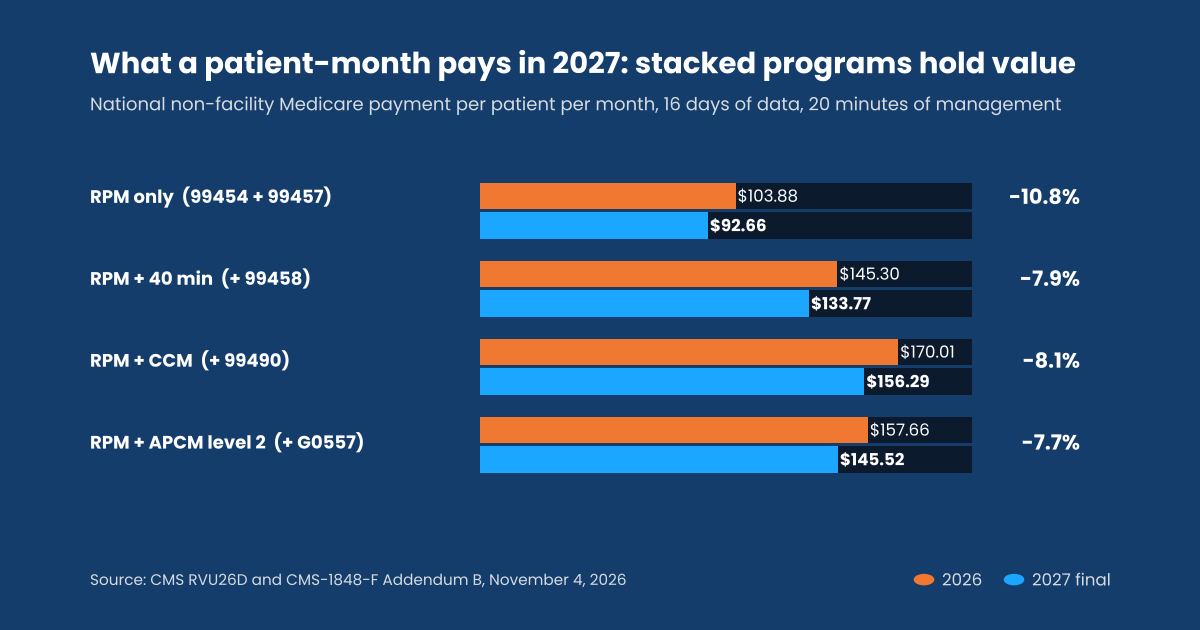
What RPM gives up in 2027 is on the device codes. CMS finalized the lower valuation, and the law spreads a reduction this large over two years, so 2027 is the first step: the device codes fall 21.1%. A patient-month with 16 days of data and 20 minutes of management pays $92.66 in 2027, against $103.88 in 2026.
The industry asked CMS to withdraw the staffing rule. CMS kept it, and gave programs two more years to prepare.
What RPM keeps
The final rule decided five RPM items. Two were dropped or delayed, one was adopted in steps, and two were adopted as proposed.
| Item | July proposal | Final rule |
|---|---|---|
| Bundling RPM and RTM into four G-codes | Request for comment on replacing the RPM and RTM codes with four bundled G-codes | Not adopted. CMS says it may consider the comments in future rulemaking |
| Staff must be employed by the billing practice | Only clinical staff employed by the billing practice qualify, from January 1, 2027 | Adopted, with the start moved to January 1, 2029 |
| Lower value for the device codes | Value the device-supply codes like the self-measured blood pressure codes | Adopted, phased: device codes down 21.1% in 2027, management codes within 1.5% of 2026 |
| A visit before monitoring starts | A separately reportable initiating visit at the start of RPM or RTM | Adopted |
| RTM only for established patients | RTM limited to established patients | Adopted |
The initiating visit. From January 1, 2027, a practitioner must furnish a separately reportable initiating visit, meaning a visit billed on its own, when RPM or RTM starts. In a well-run program the enrolling practitioner already sees the patient and decides monitoring is warranted. What changes is that this visit must be separately reportable and tied to the start of monitoring, so start capturing it and linking it to enrollment now. Three details are pending the rule text:
- whether a recent visit counts, for example one in the past 12 months (a “lookback”);
- whether the visit can be furnished by telehealth;
- whether patients already enrolled are exempt (“grandfathered”).
We will update this section when the full rule text is published.
RTM established patients. RTM can now be furnished only to established patients. RPM already has an established-patient requirement, so this brings RTM in line with what most programs do already: monitor the patients you treat.
Two years on the staffing rule
The requirement that would have ended contracted RPM staffing in 2027 now starts January 1, 2029. From then, Medicare pays for RPM and RTM services only when clinical staff employed by the billing practice furnish them. Which codes that covers is pending the rule text. Until December 31, 2028, contracted staff qualify as they do today.
That is more than 25 months. A practice signing a contract today can write the migration into it instead of renegotiating mid-term. A health system that relies on a monitoring partner can decide, on its own schedule, which work to bring in-house and how to staff it.
In July I wrote: “CMS is not trying to kill RPM. It’s trying to kill a specific way of doing RPM.” The final rule bears that out. I also made a commitment, which I restate here with the new date: every CareSimple customer with an outsourced care management arrangement will have a defined, contractually supported migration path in place before January 1, 2029. No one gets stranded mid-contract.
CMS also has two more annual rules, for 2028 and 2029, in which it can refine the requirement before it takes effect. The comment record gave it alternatives that target misconduct rather than the staffing model: registering monitoring organizations, naming on each claim who furnished the service, and auditing outliers with claims data. As I wrote in September: “The industry is not asking CMS to look away. It is asking CMS to target the conduct, not the care model, as more than 100 payers, health systems, provider groups and associations also urged.”
The 2027 rates
How Medicare sets these prices. Each code has a weight, measured in relative value units (RVUs), for the clinician’s work, the practice’s costs (practice expense) and malpractice insurance. Medicare multiplies that weight by a dollar amount, the conversion factor. For clinicians who are not qualifying participants in an advanced alternative payment model (APM), the conversion factor falls from $33.4009 to $32.6286, a 2.31% decrease. For qualifying APM participants it falls from $33.57 to $32.95, about 1.8%.
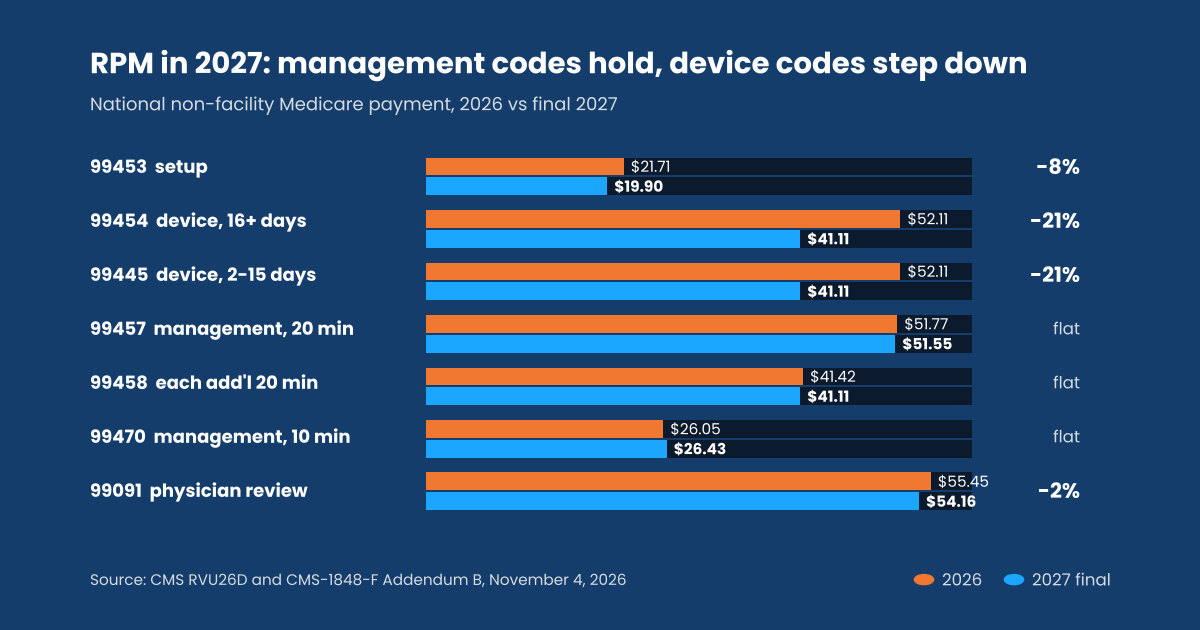
RPM is billed in three parts: setup and patient education (99453); the device and data transmission (99454 for 16 to 30 days of readings, 99445 for 2 to 15 days); and the clinical staff time spent managing the patient, called treatment management (99457, 99458, 99470).
All amounts below are national Medicare rates for services billed from a practice or the patient’s home rather than a hospital (“non-facility”). Local rates differ; the calculator applies them by locality. The last column, “fully implemented,” is the value CMS’s final inputs produce with no transition limits applied, at the 2027 conversion factor. It is a reference point, not a 2028 or 2029 rate.
| Code | Service | 2026 | 2027 | Change | Fully implemented |
|---|---|---|---|---|---|
| 99453 | Setup and education | $21.71 | $19.90 | -8.3% | $13.70 |
| 99454 | Device, 16 to 30 days | $52.11 | $41.11 | -21.1% | $9.46 |
| 99445 | Device, 2 to 15 days | $52.11 | $41.11 | -21.1% | $9.46 |
| 99457 | Management, first 20 minutes | $51.77 | $51.55 | -0.4% | $52.53 |
| 99458 | Management, each added 20 minutes | $41.42 | $41.11 | -0.7% | $41.11 |
| 99470 | Management, first 10 minutes | $26.05 | $26.43 | +1.5% | $26.76 |
| 99091 | Physician data review | $55.45 | $54.16 | -2.3% | $54.16 |
Treatment management held. 99457 pays $51.55 in 2027 and 99470 pays $26.43, both within 1.5% of 2026. CMS’s final inputs keep the clinical staff time in these codes, and their fully implemented values are slightly higher than 2027.
The device codes take the first of two steps. CMS finalized its plan to value the device codes like the self-measured blood pressure codes. Its final inputs for 99454 carry the same clinical staff time as those codes and no device or equipment cost. Because the full reduction is large, the law requires it to be phased in: when a code’s total RVUs would fall 20% or more in a year, the change is spread over two years, and CMS limits the first year’s drop to 19%. The device codes’ total RVUs go from 1.56 to 1.26. Combined with the lower conversion factor, payment falls 21.1%, to $41.11. Both codes are on CMS’s list of codes subject to the phase-in, as are the RTM device codes 98976, 98977, 98984 and 98985.
The fully implemented value for 99454 and 99445 is $9.46, about 82% below 2026. Under a two-year phase-in, the rest of the step toward that value could come as early as 2028, unless the inputs change. The 2028 value will be set in the CY 2028 rule, and the schedule is pending the rule text. The inputs can change, and that is what the next year is for (see “How to use the time” below).
Setup moves less. 99453 falls 8.3% to $19.90. A separate CMS limit on how much a code’s practice expense can move in one year, the 5% stabilization bound, keeps its practice-expense drop to 5% in 2027. Its fully implemented value is $13.70.
What a patient-month is worth
A patient-month is what Medicare pays for one patient in one month. Programs that also bill care management alongside RPM, such as chronic care management (CCM), principal care management (PCM) or advanced primary care management (APCM), lose less than RPM-only programs: between about 6% and 10% per patient-month, depending on the code, against 10.8% for RPM only. The care-management codes had no policy changes and moved only with the conversion factor and this year’s practice-expense updates, while the device codes stepped down.
Each row assumes 16 or more days of data and 20 minutes of treatment management (99454 plus 99457), national non-facility.
| Patient-month | 2026 | 2027 | Change |
|---|---|---|---|
| RPM only (99454 + 99457) | $103.88 | $92.66 | -10.8% |
| RPM plus 40 minutes of management (adds 99458) | $145.30 | $133.77 | -7.9% |
| RPM plus chronic care management (adds 99490) | $170.01 | $156.29 | -8.1% |
| RPM plus APCM level 2 (adds G0557) | $157.66 | $145.52 | -7.7% |
RPM plus APCM level 2 holds value best of the four, down 7.7%, and APCM does not require tracking minutes each month (it has patient-eligibility and practice requirements instead), which makes it simpler to run in primary care. RPM plus CCM still pays the most per patient-month, $156.29, for practices that document the time.
Scorecard: what the industry asked for and what it got
Counts come from our September review of the public comments: 110 payers, health systems, provider groups and associations and 26 RPM and digital-health companies, CareSimple among them.
| Item | What commenters asked for | What CMS did |
|---|---|---|
| Staffing rule | Withdraw it. 100 of 110 organizations opposed it and 3 supported it. 24 of 26 RPM companies opposed it; none supported it | Kept, with the start moved to January 1, 2029 |
| Four G-codes | Do not consolidate. Of the 39 organizations that addressed it, 28 opposed, 10 were conditional and 1 supported | Not adopted |
| Device-code valuation | Do not value device supply like self-measured blood pressure. 42 opposed, none supported, and 68 of 110 did not address it | Adopted, with the 2027 drop in total RVUs limited to 19% |
| Initiating visit and RTM established patients | Accept with conditions. 16 supported, 35 were conditional, 19 opposed. We supported it with a 12-month lookback and protection for enrolled patients | Adopted |
| Lookback | Let a visit in the past 12 months count, the most common condition among the 35. We also asked that enrolled patients be protected | Pending the rule text |
| Safeguards | Target the conduct instead: registration, claims identification, audits. 21 of 26 RPM companies proposed at least one | Not in the fact sheet. Pending the rule text |
Where opposition was broadest, CMS moved: it delayed the staffing rule, which 100 of 110 opposed, and did not adopt the G-codes. On the device-code valuation, every organization that addressed it opposed it, but 68 of the 110 said nothing, and CMS finalized it. For the CY 2028 cycle, the device-code valuation needs the same breadth of comment the staffing rule got, and it needs cost data behind it.
A correction to our own numbers
Our December 2025 post on the 2026 rule understated the national 2026 payment for 99454 and 99445. The CMS file says $52.11 for both, and we have corrected that post. From here on we use CMS’s published files only, so every figure can be traced to the CMS 2026 rate file (RVU26D) or the CMS-1848-F addenda, and the RPM Revenue Calculator is built on the same files.
Elsewhere in the rule
- Care management (CCM, PCM, APCM) and transitional care management (TCM): no policy changes in the fact sheet. Their rates moved with the conversion factor and this year’s practice-expense updates, between 0.5% and 4.4% lower. 99490 pays $63.63, G0557 pays $52.86 and G0558 pays $114.85.
- Telehealth at rural health clinics and FQHCs: under the Consolidated Appropriations Act, 2026, rural health clinics and federally qualified health centers (FQHCs) have no in-person requirement for mental health visits through December 31, 2027, and can be paid for non-behavioral visits furnished by telecommunication through the same date.
- ACCESS: separately from the rule, CMS’s Innovation Center is adding ACCESS tracks for heart failure, COPD, substance use disorder and tobacco cessation starting April 1, 2027.
- Collaborative care (behavioral health): CMS raised the work values of the collaborative care (CoCM) codes and the labor rates for the behavioral health care manager. The codes rise between 25% and 54%; 99492 goes from $160.32 to $246.67.
- RTM for cognitive behavioral therapy devices: 98978 and 98986 were priced by each Medicare contractor in 2026 and have a national price for the first time in 2027, $40.79.
How to use the time
The device-code valuation is the one open question in RPM, and it is a data question the industry can answer. CMS values the device codes lower because it believes devices cost less than its original inputs assumed. Its final inputs for 99454 carry no device or equipment cost at all, only clinical staff time matched to the self-measured blood pressure codes. The way to change that valuation is to show CMS what devices, connectivity and logistics actually cost per patient-month.
We expect the device codes to come up again before the CY 2028 proposed rule, which CMS typically releases in July with about 60 days for comment. That is the window to inform the 2028 value. Whether the AMA’s RUC, the committee that advises CMS on code values, reviews the RPM codes, and whether CMS asks for device invoices, we will confirm against the rule text.
If you run an RPM program and can share device, connectivity and logistics costs per patient-month, write to us at sales@caresimple.com with “RPM cost data” in the subject. We will aggregate what we receive, without identifying any organization, and put it on the record for the CY 2028 cycle. CareSimple connects patients and their care teams; the programs, and the clinical work in them, belong to the practices that run them, and so does the evidence CMS needs.
Methodology and sources
Every dollar figure in this post is a national non-facility Medicare payment computed from CMS files:
- CY 2026 rates come from RVU26D at the 2026 conversion factor.
- CY 2027 rates come from CMS-1848-F Addendum B at the 2027 conversion factor.
- Fully implemented values come from the CMS-1848-F Fully Implemented PE RVUs file at the 2027 conversion factor. That file applies no phase-in and no 5% practice-expense stabilization bound, and fully removes the indirect practice cost index (IPCI) adjustment.
- Patient-month amounts are sums of the national code rates.
Local rates differ by locality; the RPM Revenue Calculator applies each locality’s geographic adjustments (GPCIs). Comment counts are from Parts 1 and 2 of this series. Several details are pending the rule text and are not stated here:
- the initiating-visit lookback, telehealth eligibility and grandfathering;
- which codes the 2029 staffing requirement covers;
- the phase-in schedule after 2027.
This post is for information only and is not legal or billing advice.
Sources: CMS, CY 2027 Medicare Physician Fee Schedule final rule fact sheet; CMS press release, November 4, 2026; CMS PFS relative value files (RVU26D); CMS-1848-F downloads (Addendum B, Addendum E, Codes Subject to Phase-In, Fully Implemented PE RVUs, PE Algorithm Technical Memo); Social Security Act §1848(c)(7), phase-in of significant RVU reductions; CMS, ACCESS for primary care providers and referring clinicians; Part 1: the comment tracker; Part 2: what the RPM industry proposed. CPT codes and descriptions are copyright American Medical Association.
This article was designed and edited by CareSimple. AI language models assisted with research and drafting; all facts were checked by CareSimple staff.
Run your program on final 2027 rates
The RPM Revenue Calculator now uses the final CY 2027 Addendum B and all 109 Medicare localities, with 2026, 2027 and fully-implemented columns.